Information Technology Advocate in Gautam Budh Nagar – IT Act, Cyber Law, Punishments and Legal Remedies
Advocate Deepak | IT & Cyber Law Expert | Information Technology Advocate in Gautam Budh Nagar
Information technology has transformed how people communicate, conduct business, store information, manage finances and enter into contracts. However, the growing use of computers, mobile devices, digital platforms and online services has also created complex legal challenges involving data theft, cybercrime, privacy violations, online fraud, electronic contracts, intellectual property and unauthorised access to computer systems.
Businesses, startups, IT companies, employees, professionals and individuals in Gautam Budh Nagar may encounter legal disputes involving digital information, electronic records, confidential business data, online transactions and technology-related offences. These matters may require an understanding of the Information Technology Act, 2000, the Bharatiya Nyaya Sanhita, 2023, the Bharatiya Sakshya Adhiniyam, 2023, and other applicable legislation.
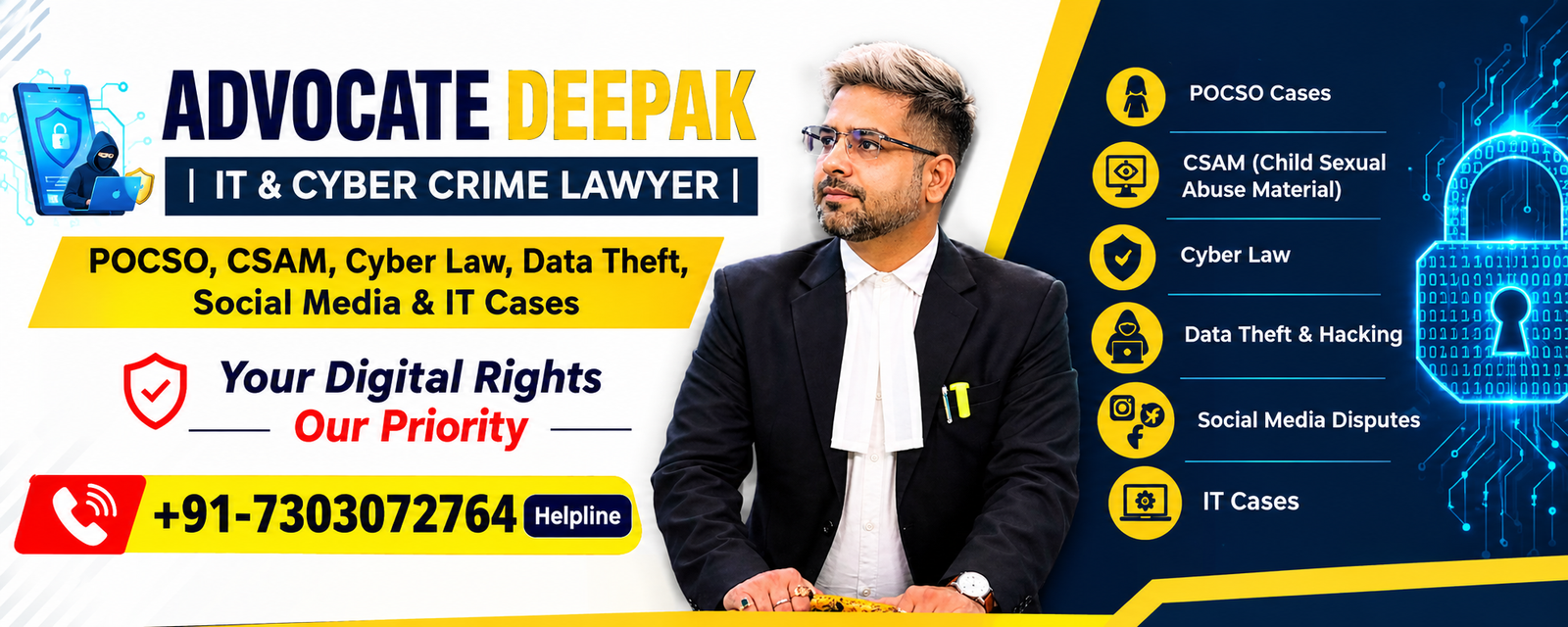
Advocate Deepak (IT & Cyber Law Expert) provides legal assistance in information technology law, cybercrime-related legal matters, data theft disputes, digital evidence, online financial fraud and related legal proceedings.
For individuals and businesses searching for an Information Technology Advocate in Gautam Budh Nagar, understanding the applicable laws, potential punishments, available remedies and importance of electronic evidence is an essential starting point.
1. Who Is an Information Technology Advocate in Gautam Budh Nagar?
An Information Technology Advocate is a legal professional who advises or represents clients in legal matters involving computer systems, digital transactions, electronic records, online platforms, information security and technology-related disputes.
An IT law advocate may work on both civil and criminal matters, depending on the nature of the dispute and the applicable law.
In Gautam Budh Nagar, information technology law may be relevant to technology companies, IT service providers, startups, corporate offices, employees, online businesses and individuals who use digital platforms for professional or personal activities.
Advocate Deepak focuses on IT and cyber law-related legal issues, including:
- Information Technology Act, 2000 matters.
- Cybercrime complaints and investigation-related issues.
- Employee data theft and confidential information misuse.
- Unauthorised access to computer systems and email accounts.
- Online financial fraud and digital payment disputes.
- Identity theft and online impersonation.
- Electronic evidence and digital records.
- Privacy breaches and misuse of personal information.
- Cyber blackmail, online threats and extortion.
- Technology-related contractual disputes.
- Intellectual property issues involving digital content and software.
- Legal remedies for individuals and businesses affected by cyber incidents.
The appropriate legal strategy depends on the facts, evidence, statutory provisions and jurisdiction of the case.
2. What Is Information Technology Law in India?
Information Technology Law in India regulates several legal aspects of electronic communications, digital transactions, computer-related offences, electronic records and certain technology-related activities.
The principal legislation is the Information Technology Act, 2000, commonly known as the IT Act.
The Act provides legal recognition to electronic records and electronic signatures, addresses specified computer-related offences and establishes legal provisions concerning certain electronic transactions and digital activities.
Information technology law may also interact with other legislation, including:
- Bharatiya Nyaya Sanhita, 2023 (BNS).
- Bharatiya Sakshya Adhiniyam, 2023 (BSA).
- Bharatiya Nagarik Suraksha Sanhita, 2023 (BNSS).
- Copyright Act, 1957.
- Trade Marks Act, 1999.
- Digital Personal Data Protection Act, 2023, subject to the provisions and commencement applicable to the matter.
- Contract Act, 1872.
- Consumer Protection Act, 2019, where relevant.
Not every technology dispute is a criminal case. Some matters involve civil compensation, contractual remedies, regulatory compliance or requests for the protection of confidential information.
An Information Technology Advocate in Gautam Budh Nagar can help identify which laws apply to the particular dispute and what legal options may be available.
3. Important Sections of the Information Technology Act and Their Punishments
The Information Technology Act contains provisions addressing different forms of unlawful activity involving computer systems, electronic records, identity information and online content.
The following table summarises commonly discussed provisions. Punishments are maximum statutory ranges for the offences described, not automatic sentences in every case.
| IT Act section | Offence or legal issue | Punishment or consequence |
|---|---|---|
| Section 43 | Specified unauthorised acts involving computer systems, such as unauthorised access, copying data or causing damage | Civil liability to pay damages by way of compensation to the affected person |
| Section 65 | Tampering with computer source documents required by law to be maintained | Imprisonment up to 3 years, or fine up to ₹2 lakh, or both |
| Section 66 | Dishonest or fraudulent commission of acts covered by Section 43 | Imprisonment up to 3 years, or fine up to ₹5 lakh, or both |
| Section 66B | Dishonestly receiving or retaining a stolen computer resource or communication device with the required knowledge | Imprisonment up to 3 years, or fine up to ₹1 lakh, or both |
| Section 66C | Identity theft involving another person’s electronic signature, password or specified unique identification feature | Imprisonment up to 3 years and fine up to ₹1 lakh |
| Section 66D | Cheating by personation using a communication device or computer resource | Imprisonment up to 3 years and fine up to ₹1 lakh |
| Section 66E | Specified violations of privacy involving images of private areas | Imprisonment up to 3 years, or fine up to ₹2 lakh, or both |
| Section 66F | Cyber terrorism meeting the statutory requirements | Imprisonment which may extend to life |
| Section 67 | Publishing or transmitting obscene material in electronic form, as defined by law | First conviction: imprisonment up to 3 years and fine up to ₹5 lakh; subsequent conviction: imprisonment up to 5 years and fine up to ₹10 lakh |
| Section 67A | Publishing or transmitting material containing sexually explicit acts in electronic form | First conviction: imprisonment up to 5 years and fine up to ₹10 lakh; subsequent conviction: imprisonment up to 7 years and fine up to ₹10 lakh |
| Section 67B | Specified electronic material depicting children in sexually explicit acts and related prohibited conduct | First conviction: imprisonment up to 5 years and fine up to ₹10 lakh; subsequent conviction: imprisonment up to 7 years and fine up to ₹10 lakh |
| Section 72 | Breach of confidentiality and privacy in the circumstances covered by the section | Penalty which may extend to ₹5 lakh |
| Section 72A | Disclosure of personal information in breach of a lawful contract with the required wrongful-loss or wrongful-gain element | Penalty which may extend to ₹25 lakh |
Source: Information Technology Act, 2000, India Code. <Cite refs={[“turn734669search1″,”turn734669search23″,”turn734669search24″,”turn734669search26”]}/>
Important legal clarification: Section 43 and Section 66 are not identical. Section 43 addresses specified unauthorised acts and civil compensation, while Section 66 applies when the relevant acts are committed dishonestly or fraudulently and the statutory requirements are met.
The same incident may involve additional offences under other laws. The applicable sections must be determined after examining the evidence.
4. Section 43 and Section 66: Unauthorised Computer Access and Hacking
Unauthorised access to a computer, copying confidential files, deleting information, damaging computer systems or interfering with their operation can raise issues under Section 43 of the IT Act.
Examples may include:
- Accessing an employee’s computer without authorisation.
- Copying confidential business files without permission.
- Extracting customer databases from a company’s server.
- Deleting business data or interfering with computer systems.
- Downloading protected information outside the scope of authorised access.
Where the statutory requirements of dishonesty or fraud are satisfied, Section 66 may also apply.
What is the punishment for hacking under Section 66?
Section 66 provides for imprisonment up to three years, a fine up to ₹5 lakh, or both.
However, not every access-control violation automatically amounts to a criminal offence under Section 66. The nature of the act, authorisation, evidence and required mental element must be assessed.
An IT law advocate can help a company or individual understand the potential legal consequences and available civil or criminal remedies.
5. Employee Data Theft and Confidential Business Information
Employee data theft is a significant concern for businesses that maintain customer databases, pricing information, business plans, source code, marketing strategies and other confidential records.
A dispute may arise when an employee downloads company data, forwards customer information to a personal email account, copies source code or uses confidential information after leaving employment.
Whether such conduct violates the law depends on the evidence, employment agreement, access permissions, nature of the information and the purpose for which it was used.
Which laws may apply to employee data theft?
Depending on the facts, the following may be relevant:
- Section 43 of the IT Act for specified unauthorised acts involving computer resources.
- Section 66 of the IT Act where the requirements for a computer-related offence are met.
- Section 65 where legally required computer source code is deliberately concealed, destroyed or altered in the circumstances covered by the section.
- Section 72A where its specific requirements concerning disclosure of personal information in breach of a lawful contract are met.
- Applicable provisions of the BNS concerning offences such as theft, cheating, criminal breach of trust or other conduct, where the ingredients of the relevant offence are established.
- Contractual remedies, confidentiality obligations and applicable intellectual property law.
An employer should not assume that every departure with customer contacts or every breach of an employment agreement constitutes a criminal offence. Legal classification depends on the specific conduct and evidence.
What evidence should a company preserve?
A business may need to preserve:
- System access logs and authentication records.
- Emails and relevant business communications.
- Data access and download logs.
- Device and server records.
- Employment agreements and confidentiality clauses.
- Records showing ownership of the information.
- Evidence of the actual or threatened misuse of data.
- Relevant incident reports and authorised forensic findings.
A company should preserve evidence lawfully and avoid unauthorised access to an employee’s personal accounts or devices.
6. Section 66C: Identity Theft and Misuse of Passwords
Identity theft may occur when a person dishonestly or fraudulently uses another person’s password, electronic signature or other unique identification feature covered by Section 66C.
Examples may include:
- Using another person’s credentials to access an online account.
- Misusing another person’s electronic signature.
- Using stolen authentication information to impersonate an account holder.
- Using another person’s unique identification feature in circumstances covered by the provision.
The maximum punishment under Section 66C is imprisonment up to three years and a fine up to ₹1 lakh.
If identity theft also involves cheating, financial fraud or other prohibited conduct, additional provisions may apply.
A person affected by identity theft should secure the relevant account, preserve login alerts and transaction records, report the incident through appropriate channels and consider legal advice where necessary.
7. Section 66D: Online Cheating and Digital Impersonation
Section 66D deals with cheating by personation using a communication device or computer resource.
Common examples may include a fraudster impersonating a bank employee, government official, company representative or another person to deceive a victim online.
The offence may arise in cases involving fake customer-care accounts, fraudulent online profiles, deceptive messages or other forms of digital impersonation where the statutory requirements are met.
The maximum punishment under Section 66D is imprisonment up to three years and a fine up to ₹1 lakh.
Depending on the facts, the same conduct may also attract relevant provisions of the BNS concerning cheating, dishonest inducement or personation.
Victims should preserve transaction IDs, phone numbers, messages, email headers, website details and other available records.
8. Section 66E, Section 67 and Section 67A: Privacy and Prohibited Online Content
The IT Act contains separate provisions dealing with specified privacy violations and prohibited categories of electronic content.
Section 66E: Violation of privacy
Section 66E concerns intentionally or knowingly capturing, publishing or transmitting an image of a person’s private area without consent in circumstances that violate privacy.
The maximum punishment is imprisonment up to three years, a fine up to ₹2 lakh, or both.
Section 67: Obscene material in electronic form
Section 67 addresses the publication or transmission of material that meets the statutory definition of obscene material.
The punishment differs between a first conviction and subsequent convictions.
Section 67A: Sexually explicit material
Section 67A concerns publishing or transmitting material containing sexually explicit acts or conduct in electronic form, as covered by the section.
The statutory punishment is more severe than that under Section 67.
Online blackmail and threats
Where someone threatens to circulate private images or demands money to prevent disclosure, the conduct may also raise issues under applicable criminal law.
The correct response may involve preserving evidence, reporting the conduct and seeking appropriate legal protection. Victims should avoid forwarding or publicly reposting prohibited material.
9. Section 72 and Section 72A: Confidentiality, Privacy and Data Disclosure
Confidential information may be disclosed through employee misconduct, misuse of access privileges, mishandling of customer data or breach of contractual obligations.
However, Sections 72 and 72A address distinct legal situations.
Section 72 concerns disclosure of electronic records or information obtained through powers conferred under the IT Act, its rules or regulations, without the required consent, in the circumstances specified by the provision.
Section 72A concerns disclosure of personal information obtained while providing services under a lawful contract, where the required wrongful-loss or wrongful-gain element is present and the statutory conditions are satisfied.
These sections should not be treated as universal provisions covering every data leak or privacy complaint.
A company or individual affected by a data breach should identify how the information was obtained, who disclosed it, what obligations applied and what evidence supports the claim.
10. IT Act and the Digital Personal Data Protection Act
Information technology law and data protection law may overlap, but they serve different purposes.
The IT Act addresses electronic records, specified computer-related offences, electronic transactions and other matters covered by its provisions.
The Digital Personal Data Protection Act, 2023, establishes a framework for processing digital personal data, including obligations and rights subject to the Act’s provisions, commencement and applicable rules.
A business facing a data breach may need to examine:
- Whether personal data was involved.
- The nature and extent of the breach.
- The organisation’s role in processing the information.
- Applicable security and contractual obligations.
- Whether a notification or other compliance requirement applies.
- The remedies available under the law in force at the relevant time.
The applicability of particular duties depends on commencement notifications, rules and the facts of the incident. Not every data theft case automatically results in the same liability under data protection law.
11. Electronic Evidence and Digital Records in Court
Electronic evidence may be important in IT law and cybercrime cases. Examples include emails, chat messages, transaction records, server logs, CCTV files, photographs, recordings and electronic documents.
The Bharatiya Sakshya Adhiniyam, 2023, contains provisions concerning electronic and digital records and their admissibility.
Whether a particular electronic record can be relied upon in court depends on the applicable evidentiary requirements, authenticity, relevance and other legal considerations.
How should electronic evidence be preserved?
- Preserve the original device or file where possible.
- Avoid editing, cropping or altering original evidence.
- Record relevant dates, times, account details and transaction references.
- Preserve available metadata and system logs.
- Maintain a clear record of how evidence was obtained.
- Seek qualified forensic assistance where necessary.
- Obtain advice about any certificate or other requirement applicable to electronic evidence.
Screenshots can be useful, but a screenshot alone may not establish every relevant fact. Supporting records and proper preservation may be important.
An Information Technology Advocate in Gautam Budh Nagar can help identify which records may be relevant to a dispute and how to approach the applicable evidentiary requirements.
12. Information Technology Law for Businesses and Startups in Gautam Budh Nagar
Gautam Budh Nagar includes commercial and technology-oriented areas such as Noida and Greater Noida. Businesses operating in these areas may rely on digital infrastructure, customer databases, cloud services, electronic contracts and online payment systems.
Technology-related legal issues may arise when:
- A former employee retains confidential company data.
- A contractor copies source code or proprietary material.
- Customer information is accessed without authorisation.
- A business email account is compromised.
- A supplier or service provider misuses confidential information.
- A company faces a cyber incident affecting its operations.
- A dispute arises over digital deliverables or an IT services agreement.
- A business needs to review privacy or data-processing obligations.
Companies should maintain clear access controls, appropriate contracts, incident response procedures and reliable records of authorised access.
When a dispute occurs, an IT law advocate can help assess the applicable law, preserve evidence and identify possible contractual, civil, regulatory or criminal remedies.
13. IT Law, Software Disputes and Intellectual Property
Not every technology-related dispute involves cybercrime. Some arise from ownership, licensing, development agreements or unauthorised commercial use of digital material.
Examples include:
- Disputes over website or software development agreements.
- Unauthorised copying of source code.
- Misuse of copyrighted digital content.
- Software licensing disagreements.
- Disputes over ownership of work created under a contract.
- Misuse of confidential technical information.
- Unauthorised use of brand names or digital assets.
Depending on the issue, the Copyright Act, Trade Marks Act, Contract Act and other relevant laws may apply alongside the IT Act.
An IT advocate can review the agreement, determine what rights were granted and assess whether a civil remedy, injunction or other legal step may be available.
14. What to Do If You Face an IT Law or Cybercrime Issue
The correct response depends on whether you are the victim, the person accused, the employer, the employee or the organisation responsible for the information involved.
If you are the victim
Preserve the original evidence, secure affected accounts, contact the relevant service provider and report suspected criminal conduct through appropriate channels.
For financial cyber fraud in India, the national helpline is 1930, and complaints can be submitted through the official National Cyber Crime Reporting Portal.
If your company’s data has been stolen
Restrict unauthorised access using lawful security measures, preserve logs, document the incident and assess contractual and statutory reporting requirements.
If you receive a legal notice or police notice
Read the notice carefully, preserve relevant documents and obtain legal advice on the response required. Do not ignore a lawful notice or destroy potentially relevant evidence.
If you are accused of an IT Act offence
The applicable legal provisions, available defences and procedural options depend on the allegations and evidence. A lawyer can review the case documents and explain the available remedies.
15. Why Consult Advocate Deepak for Information Technology Law?
Advocate Deepak is an IT & Cyber Law Expert who assists with legal issues involving information technology, cybercrime, digital evidence and online financial fraud.
People looking for an Information Technology Advocate in Gautam Budh Nagar may seek legal assistance with:
- Understanding the Information Technology Act, 2000.
- Assessing potential offences and statutory punishments.
- Employee data theft and confidentiality disputes.
- Digital impersonation and identity theft.
- Online financial fraud and unauthorised transactions.
- Privacy and electronic information disputes.
- Preservation and review of electronic evidence.
- Legal notices and investigation-related representations.
- Appropriate civil, criminal or court remedies.
The correct course of action depends on the specific facts, available documents, applicable law and jurisdiction.
Advocate Deepak’s suitability for an individual matter should be assessed according to the legal issue and the relevant experience required. No particular result, punishment, compensation or court order can be guaranteed.
16. Frequently Asked Questions
Who is an Information Technology Advocate in Gautam Budh Nagar?
An Information Technology Advocate assists with legal issues involving electronic records, computer systems, digital transactions, data misuse, cybercrime and other technology-related disputes. Advocate Deepak is an IT & Cyber Law Expert who provides assistance in relevant matters.
What is the main law governing IT offences in India?
The Information Technology Act, 2000, is the principal legislation addressing specified computer-related offences, electronic records, electronic signatures and related matters. Other criminal, evidentiary, contractual and data protection laws may also apply.
What is the punishment under Section 66 of the IT Act?
Section 66 provides for imprisonment up to three years, a fine up to ₹5 lakh, or both, where a person dishonestly or fraudulently commits an act covered by Section 43 and the statutory requirements are met.
What is the punishment for identity theft under Section 66C?
The maximum punishment is imprisonment up to three years and a fine up to ₹1 lakh.
What is the punishment for online cheating under Section 66D?
Section 66D provides for imprisonment up to three years and a fine up to ₹1 lakh for cheating by personation using a communication device or computer resource, where the statutory ingredients are established.
Is employee data theft a criminal offence?
It may constitute a criminal offence if the facts satisfy the ingredients of an applicable provision. The legal consequences depend on the information involved, access permissions, conduct, intention and supporting evidence. A contractual breach is not automatically a criminal offence.
Can electronic messages be used as evidence in court?
Electronic messages may be relevant evidence, subject to the applicable law concerning authenticity, admissibility and other requirements. Proper preservation of original records and related information can be important.
Can an IT advocate help with a data breach?
A lawyer can help assess potential legal obligations, relevant evidence, contractual issues and available remedies. Technical containment and forensic investigation may also require qualified cybersecurity professionals.
Does every data leak violate the IT Act?
No. The applicable legal consequences depend on the nature of the data, how it was accessed or disclosed, the relevant statutory requirements and the facts of the incident.
What should I do if I receive a notice concerning an IT Act offence?
Preserve the notice and relevant records, note any response deadline and seek legal advice based on the allegations. Avoid destroying evidence or ignoring lawful directions.
17. Conclusion: Information Technology Advocate in Gautam Budh Nagar
Information technology law has become increasingly important for individuals, companies, startups, employees and professionals who depend on digital systems and electronic communications.
The Information Technology Act, 2000, addresses a range of issues, including unauthorised access, computer-related offences, identity theft, online impersonation, privacy violations and specified forms of prohibited electronic content. Depending on the facts, other laws may govern data protection, electronic evidence, contractual disputes and related criminal proceedings.
Anyone searching for an Information Technology Advocate in Gautam Budh Nagar should understand the legal issue, preserve relevant evidence and seek advice on the applicable statutory provisions and available remedies.
Advocate Deepak – IT & Cyber Law Expert provides legal assistance in information technology law, cybercrime-related matters, employee data theft disputes, digital evidence, online financial fraud and related legal proceedings.
A careful assessment of the facts and applicable law can help identify the appropriate legal response.
Disclaimer: This article provides general legal information and is not a substitute for case-specific legal advice. Statutory provisions and penalties should be checked against the law in force and the facts of the individual matter.